Time in Japan

Monday, January 23, 2017

Yamasa trip to Kyoto (Part 2)


The second part of our trip to Kyoto was to a confectionery factory and shop to make some sweets!

The shop has a Pepper robot!  If you speak Japanese carefully, Pepper will respond.  I've seen Pepper at Aeon Mall, too.  I got Pepper to answer one question for me -  お元気ですか (How are you?).


Each participant got a tray of supplies and tools.


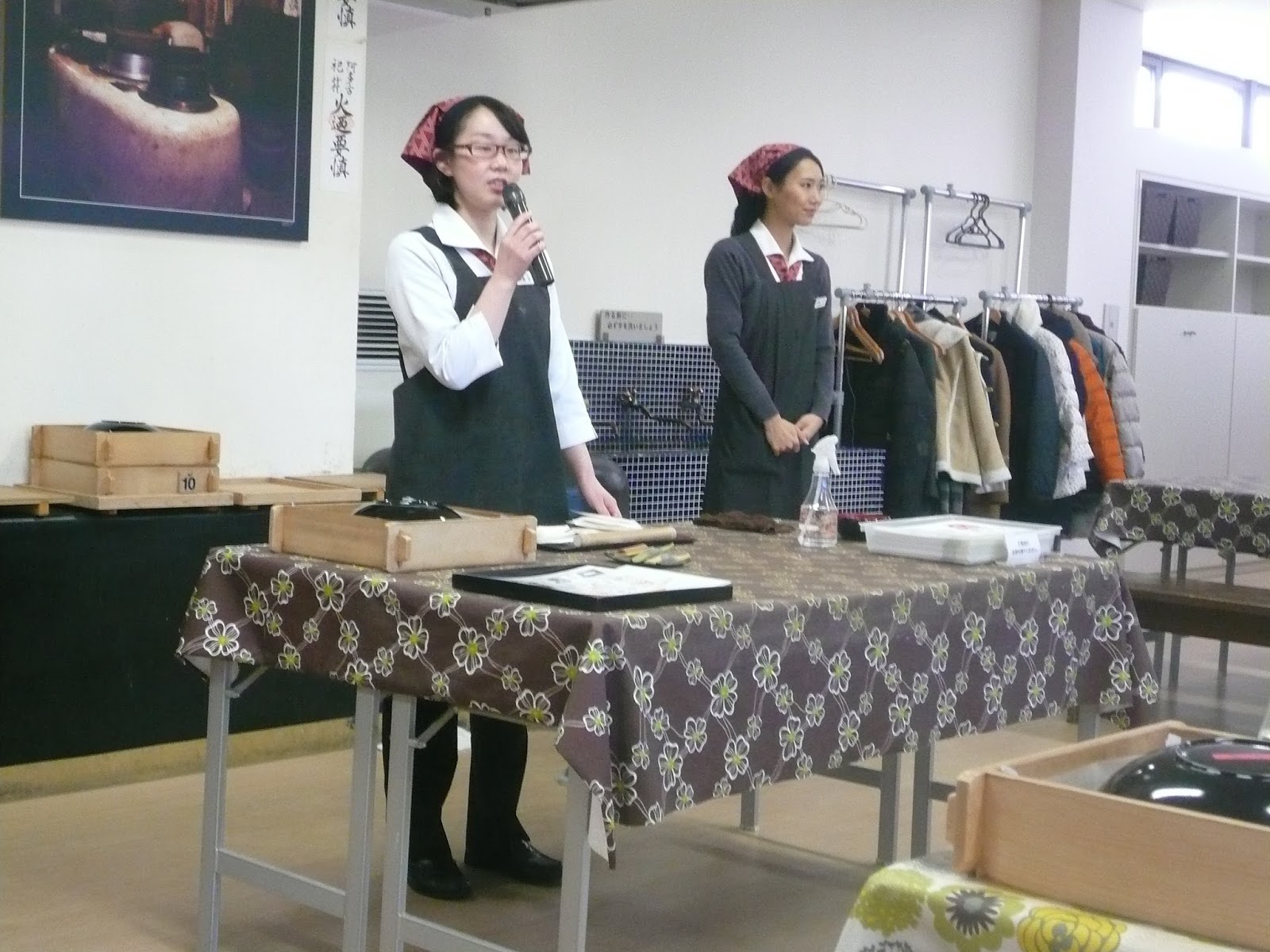
Shop staff gave directions and demonstrated how to make the sweets. 


 First, we mixed the rice flour, sugar and water.


Pour it into a tray to be steamed.  While the staff steamed our batter, we went to look at the actual factory.


 Here are our instructions


 Here is what cinnamon looks like.  This shop makes some cinnamon flavored sweets, as well as green tea flavor, chocolate and sweet red bean paste.


After kneading the steamed dough, it's divided in to three, so we can make three sweets. 


The first one has cinnamon added.  I think I could have added more cinnamon to mine.


The dough is rolled out very thinly, then cut into a square.  I put some sweet bean paste ("an") inside, and voilà!  My first sweet is done!


The next one has powdered green tea (matcha) added.


Cut a square-ish shape.


Add some green tea flavored filling.


Done!


The last one has plain dough and some other flavor that was good, but I can't recall what it was, besides yellow.


We ate our sweets, then drank a bowl of tea.  Yum!


Some people in our group thought they tasted sweet, but I think Japanese sweets aren't too sweet. However, Japanese food is sweet overall compared to Chinese food, so that might be it.

Here are some shots on the highway as we went home to Okazaki.


 Here's a ship on the horizon near Nagoya's port.


Sunday, January 22, 2017

Yamasa trip to Kyoto (Part 1)


One of the good points about Yamasa is that they regularly plan trips for students at really good prices.  I climbed Mt. Fuji on such a trip.

This weekend, I went to Kyoto with 4 other students and a teacher, along with a driver.  We went to Fushimi Inari Shrine, then to Otabe Kojo to learn to make Kyoto-style sweets.  It took about 2 and a half hours to get to Fushimi Inari Shrine from my dorm.

There was still snow on the ground.


Here's a shot of Kyoto before we got to the shrine.  My guess is that these women are tourists who have rented kimono for the day.


Fushimi Inari Shrine is tourist destination, and even in January, it's packed.  But it's also a functioning religious shrine.

Here is a large torii gate at the entrance (it's not the first one):

Torii gates represent the barrier between the mundane and the sacred.

In Japan, the two main religions are Shintoism, the native Japanese religion, and Buddhism, which was imported from Korea and China beginning in the sixth century AD.  The total number of Shintoists and Buddhists in Japan exceeds the total population by a lot because many Japanese are both.  There are some who are strictly only one or the other, but many are both, and often a Shinto shrine and a Buddhist temple will be situated together.  However, you can identify a shrine by the presence of  a torii gate.

Here are some miko, which are called "shrine maidens" in English.  Miko used to be more like female shamens, but now they mostly work the amulet sales counter and perform certain religious dances.


Inari shrines are the most common Shinto shrine in Japan.  In addition to registered shrines, there are lots of small roadside shrines, which may just be a small torii, and an alter with fox statues.

This is the stage for the religious dances.


Fushimi Inari Shrine is the head Inari Shrine.  Inari is the deity of harvest, as well as business, success in general and foxes.  Inari shrines are the most numerous type of Shinto shrine in Japan. They all have statues of foxes ( キツネ kitsune) , since foxes are messengers to Inari.


In Japanese folklore, foxes can be troublemakers, but they are not evil.  They can also change their shape to appear human.

A feature of Inari shrines is an abundance of red torii gates.  These are donated by individuals or companies.

At Fushimi Inari Shrine, there are tunnels of torii gates!


You can see old torii gates that have faded,next newer ones.


At one point, the tunnel divides into two, made up of smaller torii gates.  You go up on one side and come back on the other.


Here, you choose one of two stones.  Say a prayer and make a wish, then estimate the weight of the stone in front of you.  Now, try to lift the stone.  If it weighs less than you thought it would, your wish will come true.


 Here are some much smaller torii gates.


These are ena.  You buy one, write your wish on it, and leave it here.


Several more foxes.


The torii gates from the side.


A bamboo grove.


One of a pair of dragon statues.


This fox is holding a key. 


 Here is the shrine.  To pray is very simple.

  1. You'll have purified yourself by washing your hand and rinsing your mouth at a fountain near the entrance to the shrine grounds.
  2. Toss an offering into the box.  5 yen coins and 50 yen coins have holes in the middle, and are considered lucky offerings.  You offer as little or as much as you want or are able.  No tithing here.
  3. Ring the bell.  Swing the rope; don't pull it.
  4. Bow twice.
  5. Clap twice.
  6. With your hands held in prayer, express your gratitude or make a request silently.
  7. Bow one more time.  You're done. 

Some shrines have a different number of bows or claps.  But you won't incur the deity's wrath if you do it wrong.


If you've seen pictures from Nikko Toshougu (mine or anyone else's), you'll see a similarity in the carving style and colors used between the carvings there and here:


Information about the shrine:


Near the shrine are food stands and restaurants.  Ms. Suzuki and I had some Hiroshima-style okonomiyaki.  It has noodles in it, unlike the kind I usually make, which is Osaka style.


One last look at the main gate


 This fox is holding some rice or barley:


Another fox with rice or barley.


This one has nothing.


Stay tuned for part 2!

Friday, January 20, 2017

Living the Dream!


Today was the kind of day that is why I am here.  If I really am dreaming, don't wake me up.

I love seafood.  One kind of fish I really like is makerel, or saba in Japanese.  The nearest place that I can buy it is from Mitsuwa in Arlington Heights.  I can get a different sort of mackerel at a Korean grocery store in Appleton.  It's not the most expensive seafood, but it's not cheap, either.

Here, I can buy two halves of a fish for under ¥198 (plus tax).  That works out to $1.86 with tax. That's enough fish to make two meals for my husband and me.


It's an oily fish compared to white fish, like cod or haddock.  But the oil is the stuff that we spend good money on in capsule form when we buy fish oil capsules.

I don't remember how much I paid for this at Mitsuwa, but it was definitely more than $2!

Here is how my lunch turned out:


That's fried yakisoba noodles, fried saba (mackerel), with onion and shimeji mushroom in a soy-miso sauce on top, and a cut up tomato.

On Fridays, we only have class in the morning.  I think this is done to allow students to get a head start on their weekend trips -- or in recognition that they will do this regardless.

I spent some time this afternoon at a nearby onsen.  It may be a sento (no natural hot spring on site to provide the hot water) instead of an onsen (an actual hot spring provides the hot water), but it's good enough for me.  ¥700 is the entry price to heaven, in case you're wondering.  Today, that's $6.08.

If you ever get the chance to go to a Japanese onsen or sento, I cannot recommend it highly enough. I can understand the lack of onsen in the US, but the lack of sento is a crime. A hot tub is close, but the ones I've seen won't allow the water to be hot enough. Today I was soaking in 111°F water.

Remember to follow the rules, though:

  1. You have to take all your clothes off in the locker room.  No swimsuits allowed.  Don't worry -- almost all are gender segregated, although you'll see women bring in very young children of either gender.
  2. There is an area to thoroughly wash yourself before entering any of the baths.  Be sure to do so.
  3. Bring or rent a small towel. You can use this to cover your dignity (or not) when going between baths, but don't bring it into the bath. Either set it down outside the bath, or set it on your head.
  4. If you have tattoos, there is a good probability you will not be allowed in.  This is to keep out the yakuza (Japanese mafia), who tend to get full-body tattoos. Of course, they like onsen as much as anyone else, so there are onsen that will accept them. If you have tattoos, you may just have to find out where the mob goes to soak.

If you can't get past being naked in front of naked strangers, there are resorts that have private baths, so you can bathe with only the people you want to, or by yourself.  I personally think the experience is worth it and in the right context (this one), I have no problem with public nudity.  There is absolutely nothing sexual about onsen or sento.

Here you can see the baths at Okazaki's Raku no Yu.

Thursday, January 19, 2017

Accent reduction


In the course I'm taking, we get one elective.  I chose pronunciation and intonation, since I can study reading easily at home, but don't have access to native speakers who will repeat things when I ask.  I usually don't have trouble having my words misunderstood, but I want to reduce my accent as much as possible.  In Japanese, that means both getting the sounds right and mastering pitch accent.

Japanese is not a tonal language like Chinese or Vietnamese, but it does have what is called pitch accent.  It's like a two tone system, but a word's pitch pattern can sometimes change depending on the words around it.

It wasn't taught at all in the college Japanese course I took, but it matters.  Words that have the same sounds but different meanings can have different pitch patterns to distinguish them.  An example would be two words that are pronounced 'hashi'.  One means 'bridge' and the other, 'chopsticks.'  One starts out high, and goes low and the other does the opposite.  Please check out the videos listed below for examples that explain this way better than I can in writing.

I'm reminded of several Indian instructors I had in college.  Their vocabulary and grammar were very good, or even excellent, but they stressed the wrong syllable on words often enough that it was hard to understand them at first.  Eventually I caught on to their accent, and could understand what they were trying to say.  For example, one professor would stress the first syllable of 'develop', and at first I thought that 'devil up' was some sort of Indian English slang that meant about the same thing as 'develop'.

I'm also learning more about Japanese phonetics.  English consonants like  T or K will give good approximations, but the Japanese pronunciation is softer, with less air produced.  The T is more like it is in Spanish.

Our teacher has really good English pronunciation, so she can do a good, but slightly over the top, impression of an English speaker speaking Japanese.

This kind of accent reduction is exactly what I'd hoped to get from this class.

For anyone who wants to learn more about this, here are some introductory videos:

Japanese intonation: word-level
Japanese Phonetics (Patreon Series): Episode 1


Tuesday, January 17, 2017

Decorative English


What I call "decorative English" can be found all over Japan.  Whether it's on a t-shirt, the cover of a notebook or in an advertisement, this English can have a strange meaning or no meaning at all.  My favorite is still the first instance of decorative English that I ever saw:  Bedight the limpid.

It was on a t-shirt.  Don't ask me what the designer meant to say; I have no idea.

Before you think I'm laughing at someone else's expense, let me assure you that there is a corresponding phenomenon in the West:  the decorative Chinese character or kanji.  I know at least one person who had Chinese characters tattooed on their body, but has no idea what they really mean, or if they mean anything at all.  I have decorations with Chinese characters on them hanging in my bathroom at home.  I've checked, and they do actually mean something.  But I'm sure many people buy these things without caring or knowing what they mean. They just look nice.

So, here is an example that I saw today -- Feel News.


Usually saying, "I'm going to Feel" doesn't imply physical action but today, it did.

There's a supermarket, a clothing and bedding store, a drugstore and a 100 yen shop inside.  I think the grocery story has the best prices of all the nearby grocery stores, but it's in the opposite direction from everywhere else I need to go.

Monday, January 16, 2017

Compare and Contrast


I've always been fascinated by the differences between cultures. I do believe that there are some things that are right or wrong, but there are so many aspects to life that can be approached in a variety of ways that are neither right or wrong, just different.

Here are some differences I've seen between Japan and the part of the US where I live.

Traffic Signals

At an intersection between my dorm and the school, the arrow to turn right follows the green light, while I'm used to the arrow to turn left coming before the green light.

Also, Japan drives on the left side of the road.

Recycling

In my neck of the woods in the US, we separate our trash into paper, recyclables (glass, PET bottles, metal cans), and everything else.  The only rule for putting it out at the end of our driveway each week is that the recyclables need to be in a blue bag.

Here, separating trash is a science.  There is burnable trash, non-non burnable trash, plastic bags and containers, PET bottles, glass bottles, cans, paper and large items.  When I lived in Tochigi, grocery stores had receptacles for cleaned and flattened milk containers, too.  Burnable trash, which includes kitchen waste, is collected more than once per week.

In Japan, each neighborhood has a trash collection point; you don't leave the trash at the end of your driveway (if you have one).  You also have to buy official bags for certain kinds of waste.  This way, those who throw away the most, pay the most.

This may seem a little extreme, but Japan doesn't have the room for landfills that we do in the US.

Paying at the store

In Japan, there is a tray by the cashier, into which you place your money.  Don't hand it directly to the cashier.

The consumption tax recently went up to 8% nationwide from 5%.  It applies to food, unlike Wisconsin's sales tax.

Heating and Cooling

In the US, we have central heating, and quite often, central air.  In Japan, rooms are heated and cooled individually.  Usually an air conditioner will also provide heat.  The main unit is outside, and the fan and control are mounted on an inside wall near the ceiling.  There is also a remote control.


This is for economy and energy efficiency.  On the plus side, you don't have to seal off rooms you're not using in order to not heat them.  On the other hand, areas like hallways can be cold or hot.

Laundry

Clothes dryers are not common in Japanese homes.  This is partly for economy and space reasons, and because hanging clothes out to dry is better for them. I'd love to be able to do that but we only have part of the year where it would make sense, and during part of that, there are lake flies.

Laundromats have dryers, of course, for when you really need one, like during rainy season.

Imported Cars

At home, my hubby and I have a Volvo and a Kia.  We've also owned domestic cars, like Chevy or Buick. But I have seen far fewer non-Japanese cars here than I see non-American cars back home.

Aichi Prefecture is home to Toyota, so of course, there are more Toyotas around here than anything else.  Car ownership is also greater in this area than in other places.