Time in Japan

Monday, January 16, 2017

Moving


The Yamasa Institute is a not-for-profit organization, which receives funds from the Hattori Foundation.  One of the companies connected with this foundation is Artec, which makes bentos (prepackaged lunches) without chemical flavoring for institutions like hospitals and schools.  They also sell some in the lobby at Yamasa.

I bought one today, for ¥540 ($4.74 at today's rate) after tax. It was delicious and substantial at 800+ calories.

That's lettuce, a salace, rice, fried chicken and potato, and behind the chicken is a bean salad ann another salad behind the potato.  It was really good.

If you're not jealous yet, this is similar to Japanese school lunches.  No pizza flips here!  Delicious and healthy!

There is a coffee vending machine that makes a cup of tea, coffee or hot cocoa for only ¥100, and you can choose how dark you want your coffee, how much sugar and/or cream you want in it.  It also does it faster and more quietly than the Keurig machines do.  Hot matcha latte is a wonderful thing.

After school, I changed rooms at the dorm.  Yesterday, the air conditioner stopped heating. The caretaker kindly lent me a space heater for the night, and today I moved across the hall to my new room.

When I told the school, they wanted to check it out and try to fix it at first.  I suggested changing rooms, and after I assured them that it would be no problem for me, I got a key to my new room on the spot.  Easy peasy!

Saturday, January 14, 2017

Ume


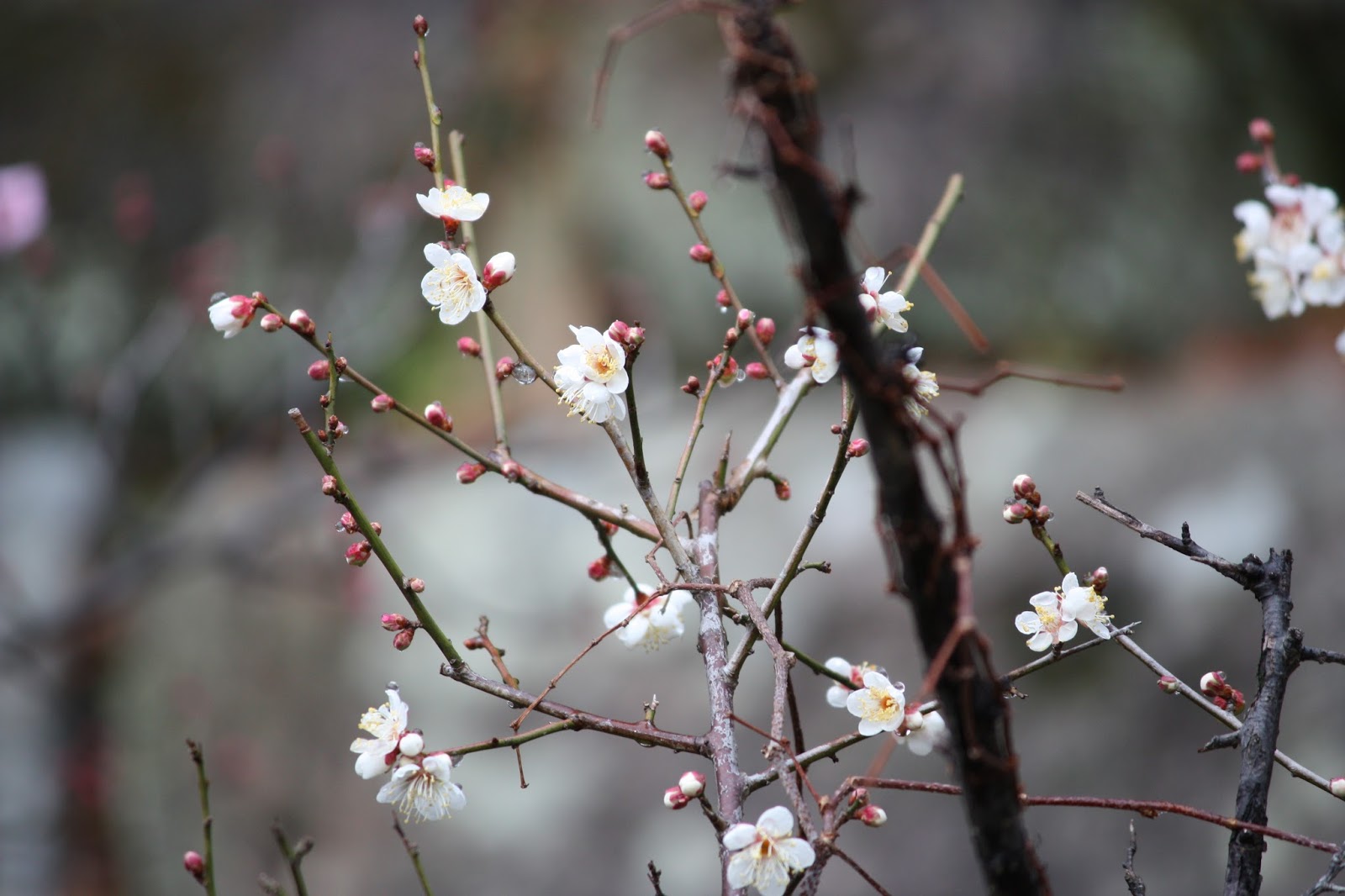
Ume (pronounced approximately Oo-may) is Japanese for plums.  Plum flowers bloom earlier than their showier sisters, the cherry blossoms, and get less publicity.  But they are still appreciated here.

Here are some pictures that I took at the castle today of plum blossoms.


A crappy day touring beats a good day at work!


Today's adventure takes us to some of Okazaki's tourist spots around Okazaki Park. I took the train to Naka Okazaki Station, which is two stations away from Okazaki Station, which in turn is about 25 minutes from my dorm.

First up is Hatcho Miso. Actually, there are two separate companies that make miso in this area. This is dark miso. The name Hatcho means "Eight Blocks" because these factories were eight blocks away from the castle.

The factory I visited was the first one I found, Maruya. They've been making miso since 1337, so I think they have it down by now.

Miso is fermented soybean paste, which is high in protein and gives food that delicious umami flavor. Hatcho miso has been linked to reduced cancer rates as well, and was sent to Fukushima after the nuclear accident there.

Here are vats where miso is aged. The stones on the top press the miso to extract water and some of the salt used to make it. Stones stacked that way are used so the pressure is even and they won't fall off or tip the vat over in case of earthquake.


Here you can see more of the facilities, along with the delightful weather. Yes, that's snow.


Here is the other factory.


I was given a small packet of miso as part of the tour, but I also bought a bigger one. I like miso, in soup and sauces.


If you have not tried miso yet, I recommend that you do. Don't eat it straight though. Find a miso soup or sauce recipe. But be careful to add it at the end, since the flavor can be destroyed by excess heat.  Also, there are different kinds of miso; white miso is milder than the darker varieties, if you want to start cautiously.

Here are some recipes to get you started.  (Slideshow warning) I have tried none of these, but they look really good!

After the miso factory tour, I headed for Okazaki Castle. Okazaki Castle's claim to fame is that Tokugawa Ieyasu was born here. He was the final unifier of Japan, after Oda Nobunaga and Toyotomi Hideyoshi. He started the Tokugawa Shogunate, which ruled Japan from 1603 and 1867. If you remember Clavell's "Shogun" (the book and/or miniseries), the character Toranaga was loosely based on the real Tokugawa Ieyasu.

Japan is and is not a pedestrian-friendly place. Here is an example of pedestrian-friendliness. To cross this intersection of two busy streets near the castle, pedestrians go up stairs at any of the four corners, then walk around an elevated circle to their chosen corner and descend.


There is a flat surface on the stairs so that cyclists can walk their bikes across the intersection, too!


Like most castles in Japan, Okazaki castle is a reconstruction. Many castles were demolished after the Meiji Restoration as Japan raced to modernize and westernize in the late 1800's and early 1900's. Castles were seen as reminders of Japan's previous backwardness. Others were damaged or destroyed in WWII.

Here is the main gate.


Near the gate is a phone booth, suitably designed to fit in!


A clock.


Here's a random flower on the grounds.  It was cold, windy, and alternately raining and snowing, but it's still closer to spring in Okazaki than it is in Oshkosh.


Here's the actual castle.  It's not the biggest castle in Japan, but it's still very good looking.


The grounds are larger than just the castle. There is also a museum with lots of relics from the castle and it's occupants.  

No photography was allowed inside the castle or museum, so I can't show you the arrowheads I saw that actually had flower designs punched out of them. So these were warriors with a soft side that appreciated fine art and craftsmanship.

If you come in the near future, adult admission for both the castle and museum is ¥510.

I hope to come back when my Japanese ability allows me to read more. There are bits of English in both the castle and museum, but I'm sure being able to read all the signs would have made for a richer experience. I say that with the full realization that since this is Japan, the onus is on me to be able to read the signage in Japanese.

On the train ride back, I was struck by an announcement that was actually in a male voice (or the usual voice actor had a really bad cold that day!). I've never heard a pre-recorded, "The train is coming. Please stay behind the yellow line" announcement in a male voice before!

Overall, I had an enjoyable day despite the weather. I want to learn about Japanese history in more depth, so this was a great visit for me.  


Friday, January 13, 2017

First Day!


Today was the first day of classes.  On Fridays, there are 3 hours of class.

I am in Class SC, which I think is the highest one before the conversation level.  Besides me, there are three other students:  a man and woman from Brazil, and a man originally from Hong Kong, but most recently going to college in Korea.

We could choose between pronunciation/intonation or kanji for our optional classes.  I really want to learn kanji.  However, I can study kanji somewhat at home, but not pronunciation, so that's what I chose.

Today we covered one the ways to say, "if/when A, then B" in Japanese.  The grammatical term is "conditional".  So far I know of three ways to express the conditional in Japanese, and the difference mostly centers on whether a person's will is involved and how inevitable B is, given A.

One of our activities reminded me of "Shark Tank".  We had to come up with a product, draw a picture of it and describe it to the class.  Everyone else would ask questions, then give constructive criticism, like, "If it was cheaper, I'd buy it" or "If it was pink, I'd buy it".  Two of us tried to sell a kotatsu (a table with a heater underneath and quilt on top).   I guess we are all feeling a bit chilly!


Picture is not mine.  You sit at the table to stay warm.  Cats like them, too!

After class, the four of us met with two other people (Czech and Australian) to eat lunch.  Our first restaurant choice didn't have room for all six of us, so we went to a ramen restaurant.  I had very good gyoza and a beer.

After that, we lost one person, met up with another student (French Canadian) and went to a coffee shop.  I had an interesting conversation about world politics in general, movies, and why we were all in Japan, in a mix of English and Japanese.  Fun!

One of the neat things about Yamasa is that the students aren't all college age.  I was the oldest in our group but not by much.

Isn't this the cutest little milk pitcher?


Here's the cheesecake souffle I enjoyed.


Afterwards, I went to the ¥100 shop, for laundry supplies.  Oops, I accidentally bought detergent with bleach in it, so I have to go out to get something else.

Before class, I purchased a SIM card for my phone.  Now I have to put money into my account.  Then I'll be able to get internet access (Yay -- maps and train schedules!) on my phone.  I have free WiFi on campus and in my dorm, but there will be times when I'll want access while I'm out and about.


Thursday, January 12, 2017

Let's start!


I'm in the SILAC (Short Intensive Language Acquisition Course) program, which has an emphasis on conversation and students can start any week. This contrasts with the other programs which are considered long term, and run from 1 quarter to 2 years.

At the start of a SILAC course, each student takes a placement test so they be assigned to the class that is closest to their level.  For me, the speaking test was the hardest, because listening and speaking are the two skills I have the least opportunity to practice at home.  In principle, students should at least know hiragana before attending Yamasa, but it won't prevent anyone from studying at Yamasa. Yamasa uses the immersion method -- Japanese taught in Japanese.
Are you asking me what hiragana is?

Japanese is written using 4 sets of symbols:  Kanji, hiragana, katakana and occasionally the Roman alphabet -- all used together. Hiragana is phonetic, and any Japanese word can be written in hiragana. It's the first thing kids learn to read in school.

After the placement test, we had an orientation, followed by an entrance ceremony.

Some things have changed at Yamasa since I was here last.  The biggest difference is one of the staff has left as started his own school.  I don't know if there were issues or he just wanted to go on his own.  Nice guy; brought a can of Guinness to the top of Mt. Fuji to share.

Tomorrow, my actual classes start.

Dinner tonight is two of these yummy, fluffy, steamed dumplings with meat stuffing.  If anyone asks if you want nikuman, the answer is "yes!"


Here's a random street, just to give you an idea of how things look in the residential area around the school.  I love these roof tiles!


Oh, yeah...

Here are 2 things I meant to mention before:

1.  On the flight from Detroit to Nagoya, I saw two people who looked like these vloggers: Rachel and Jun.  Their YouTube videos are about the differences between Japan and the US, and I've enjoyed several of them.

2.  WingTown mall is called that (I think) because it's in 羽根町/Hanecho, literally "Wing Town".

Wednesday, January 11, 2017

To Okazaki


The bus stop to Okazaki was in the same area as the hotel bus, so that was easy.  

After I got to Okazaki station, I called the school and they sent a driver. I stopped at the school to fill out some papers, get my room key, then got a ride to the Student Village.
I've stayed at the Student Village before.  It's nice, but it's a dorm.  I would have preferred an apartment, but that's more expensive. I'm not sure I'd want to stay more than 3 months at the Village, and maybe it's not allowed anyway. There are toilets and showers on each hall, and a kitchen and laundry downstairs.  

After getting settled in, I walked around a bit. There is a convenience store literally right in front of the Village. A relatively small mall is a few blocks away, complete with a grocery story, Tsutaya book store and a Uniqlo clothing store.

Further afield is the Aeon Mall, which has grown since I've been to Okazaki, almost 9 years ago. There is a Don Quijote store near the mall, and a Loft store inside. Loft is like Tokyu Hands, which is my very favorite store. It's hard to describe, but they have lots of neat, useful things and an amazing stationery section. At both Tsutaya and Loft, I found Life notebooks for ridiculously low prices.  

I had wanted to get a Hobonichi techo (planner) at Loft, but the selection was slim since we are halfway through January. But I found a cute Weeks version of the Hobonichi, with kitties on the outside. The selling point to the Hobonichi is that it uses Tomoe River paper.

Of course McDonald's is in Japan -- but apparently, this one delivers!

Here are my food choices since I got to Okazaki:

Potato Croquettes


Maguro rolls (uncut)


Dango


After all that walking, I was really tired. But I don't really need an excuse to go to a sento. A sento is a public bath, similar to an onsen. Technically, an onsen is a natural hot spring, and a sento heats the water.  

Trivia: the "sen" in "sento" refers to an old monetary unit, the sen, which was 1/100 of 1 yen, and how much it cost to go to a sento.

Not trivia:  If you get the chance to go to an onsen or sento, try to get over any problem you have with being naked in front of your own gender and enjoy!  41C is very hot water and very nice. Your body will thank you. Mine has already forgiven me for today's walking!

Here's  link to the one I went to:  http://www.rakunoyu.com/okazaki/

Today is the day! And it's tomorrow, too!


Today's the day!

I flew from Appleton to Detroit to Nagoya.  The airport is actually in Tokoname on a man-made island.

And I lost a day somewhere over the Pacific.  I left on Jan. 9 and landed on Jan.10.

The plane was late getting to Detroit from Paris, so there was a delay.   The flight itself was not bad, for 14+ hours.  Yes, Delta will actually feed economy passengers on long haul international flights. But if you want the Kobe hamburger steak, sit closer to the front than row 28.  The chicken was not horrible, though.

One of the featured movies was "Bridget Jones's Baby", apparently a sequel to a movie I'll never see. However, they did have "君の名は"/"Your Name", which is as awesome as its box office numbers would suggest.  Definitely go see it.  That and an Asahi are a great way to start your flight to Japan!

Because my flight landed late in the evening, I had booked a hotel for the first night. Finding the bus stop for hotel bus was a bit of a challenge. I could see the hotel, but knew the road didn't go there directly, and wasn't pedestrian-friendly.  I found it eventually, though.

For around $50, I got a small, nice room, though.  I stayed on the 13th floor, a first for me -- a hotel with a 13th floor!  They also had a 4th floor, which is the Japanese equivalent of a 13th floor.  Four is unlucky because one word for it, shi, sounds like the word for death.


There was also a free breakfast buffet.  I chose a croissant, salad, potato salad, salami and scrambled eggs with orange juice  and coffee.


This was outside the front of the hotel.  It might be connected to the Dali shabu-shabu restaurant; I'm not sure.


This was in the back:


If you ever need a hotel near Chubu Centrair airport, and would like to save some money, try the Toyoko Inn.  Not 5 star, but nice enough.

Edit:  I've re-attached the pictures.  Please let me know if any are still not visible.


Monday, January 2, 2017

Happy New Year!

新年明けましておめでとうございます。
(Shinnen akemashite omedetō gozaimasu)

Happy New Year!

I hope that 2017 is kind to all of us, full of health, wealth and happiness -- and much less drama.

I will start my new year with a little adventure.  Yay!


Friday, December 30, 2016

It's been a while!

Stay tuned...more to come.